
School for Ministry
Requirements & Curriculum
Diaconal Ordination Requirements & Curriculum
Parish Discernment
Those who believe they may be called to the office of deacon begin by consulting with their rector, who may choose to write a letter to the diocese recommending that the individual begin the ordination process. After receiving and reviewing the letter, the diocese may then give permission for the person to begin praying and walking through a series of reflective meetings with their local parish and Rector. This process, called Parish Discernment, typically takes a few months to complete. If and when these parish members and Rector agree that nothing is holding the individual back from pursuing a diaconal calling, the Discernment Committee communicates this to the diocese in a formal letter, and the individual receives permission to formally apply to the School for Ministry. Once accepted, the ordinand becomes an Aspirant. From this point forward, the individual will engage in a series of trainings for the body, mind, and soul in the form of completing Diocesan Discernment, Theological Formation, and Local Formation for the Diaconate.
Diocesan Discernment
Diocesan Discernment for the diaconate includes going through a thorough background check, completing two different safety trainings, and undergoing wellness assessments with a trained professional.
Theological Formation for the Diaconate
Our School for Ministry seeks to provide ordinands with a rich understanding of Scriptural texts, as well as a thorough understanding of Anglican theology. Diaconal Theological Formation involves ordinands joining together into cohorts who will move through four Learning Modules - Old Testament, New Testament, Anglican History, and Anglican Theology - are taught by qualified Facilitators who will hold regular seminars (about every other week) for the cohort to discuss learning to date and to personally check in with ordinands.
Each Learning Module consists of Ridley Institute lectures and readings, diocesan distinctive readings, reflection questions, and seminar cohort discussions that aim to apply theological truths to practical ministry. The four Modules will run over a 12-month period, and there will be two entry points per year into the School, one in September and one in February (allowing for two cohorts per year). This rhythm of lecture, reading, reflection, and discussion, carried out in community and under the guidance of a well-trained teacher, fosters the deep theological flourishing of each ordinand.
Ordinands will then take a diaconal Summative Assessment at the conclusion of the Learning Modules. The Summative Assessment can be either written or oral.
Local Formation for the Diaconate
Following a program designed by the diocese, an ordinand will be locally formed through training alongside their rector, learning the rhythms and needs of their local parish as well as participating in spiritual formation exercises and conversations. This work helps the ordinand to reach a deeper, richer understanding of their calling to ministry while also practically preparing them for it.
Those who believe they may be called to the office of presbyter follow many of the same steps detailed above, beginning with Parish Discernment as already detailed.
Diocesan Discernment
Diocesan Discernment for the presbyterate includes going through a thorough background check, completing two different safety trainings, undergoing wellness assessments with a trained professional, and completing an assessment with a Clergy Discernment Committee.
Theological Formation for Presbyteral Ordinands
Those in the presbyteral track are required to complete an advanced degree in Divinity, Theology, or Religion (MA, MDiv, PhD Theology, Church History, etc.) from an approved institution and to submit transcripts to the diocese. After a transcript review, the candidate will receive permission to sit for a rigorous Theological Assessment Exam that tests their knowledge of the Bible, Anglican history, and doctrine.
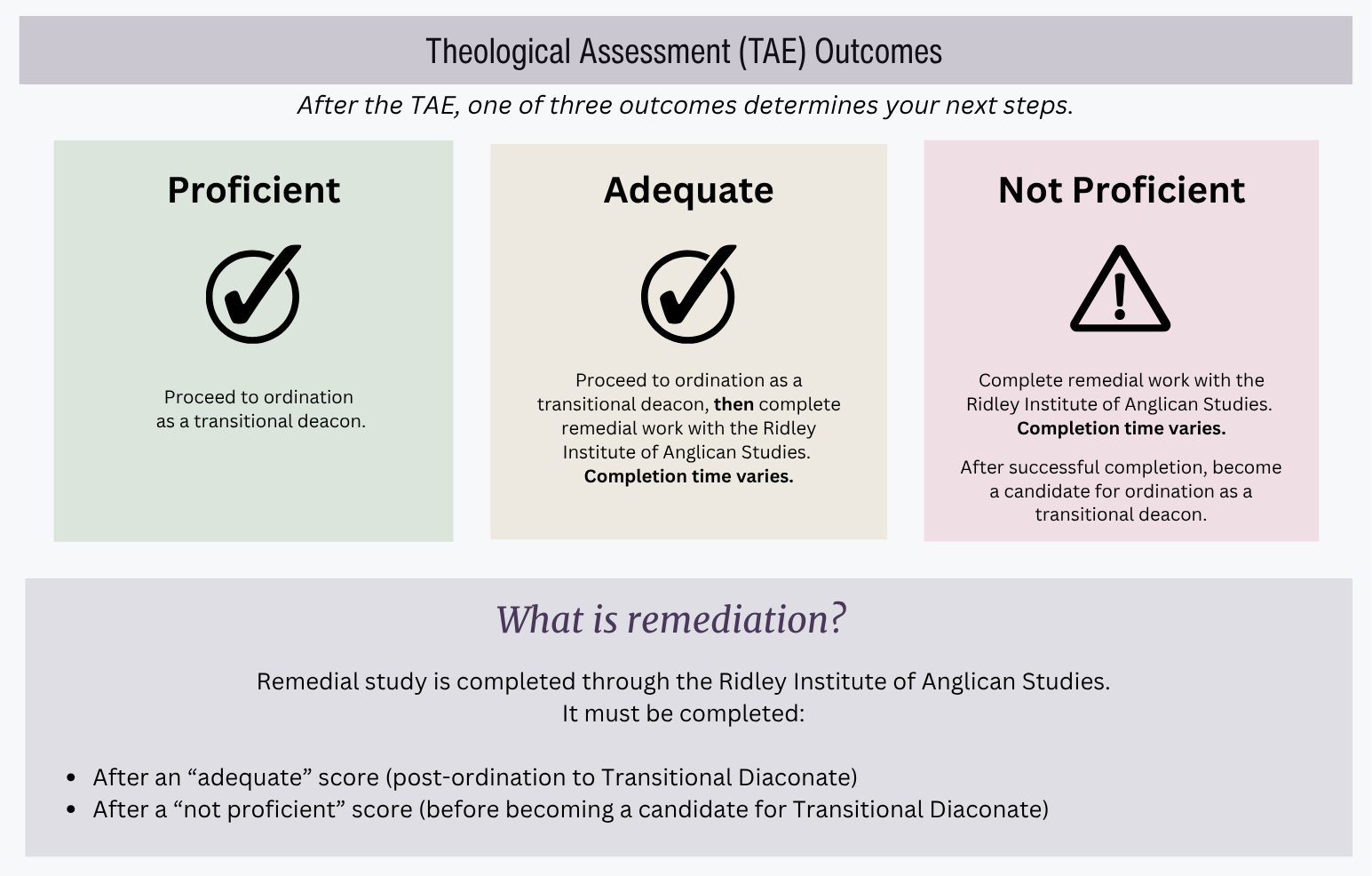
A qualified diocesan grader will then work with the ordinand to assess their theological readiness. The candidate will receive either a “Proficient,” “Adequate,” or “Not Proficient” score on their exam. If they receive “Adequate” or “Not Adequate,” the Director of Credentialing and other School for Ministry staff will design custom coursework for the ordinand to strengthen or deepen specific aspects of their theological training.
Further details below:
Presbyteral Ordination Requirements & Curriculum
Local Formation for the Diaconate and Presbyterate
In order to become an Anglican presbyter, one must first pursue and practice the office of deacon. Therefore, like diaconal ordinands, those seeking eventual ordination to the presbyterate must complete the requirements of Local Formation for the Diaconate. After being ordained to the diaconate, they then undertake a second period of formation by completing Local Formation for the Presbyterate. This formation includes further interior work as well as practical training relevant to the office of the presbyter, such as administering the sacraments, hands-on service, practical leadership coaching, and additional structured practice preaching the Word of God. This work helps each presbyteral ordinand further prepare for their future ministry by cementing their understanding of the Scriptures and theology in relation to practical ministry, and by deepening their own spiritual life.